


Osteoporosis is a growing public health issue around the world. According to the latest data from the International Osteoporosis Foundation, this disease affects one in three women and one in five men over the age of 50 years old, worldwide.1
The disease is characterized by a gradual loss of bone strength that leaves your skeleton brittle enough for a minor stumble to cause a serious fracture. Symptoms often include back pain, loss of height, poor posture, and frequent small fractures.2
What’s worse, many people don’t realize they have osteoporosis until a hip fracture changes their entire lives overnight. Left untreated, osteoporosis increases disability, dependence, and even mortality.3 And despite advances in health care, research predicts hip fracture rates will double by 2050.4,5

Global Study Warns of Rise in Osteoporosis Cases
In a 2023 scientific review published in the Journal of Bone and Mineral Research, researchers compiled data across multiple countries to map fracture rates, post-fracture treatments, and long-term survival outcomes. Their conclusion was unambiguous — hip fracture rates are predicted to double by 2050, driven largely by population aging and a global failure to properly treat osteoporosis after the first fracture.6
• The study’s focus was on older adults, especially those over 65 — This age group experiences most cases of hip fractures. The team’s analysis revealed that even as modern medicine extends life expectancy, the ability to keep bones strong enough to support that extra longevity has fallen behind.
The result is a growing wave of fractures among seniors — each one threatening independence, mobility, and life itself. In many countries, women face higher fracture rates due to postmenopausal bone loss, while men often experience worse survival outcomes once a fracture occurs.
• There are wide differences in how well countries are managing bone health — Western Europe and North America have seen modest declines or plateaus in fracture rates due to improved awareness and screening. In contrast, Asia and South America are facing dramatic increases, as urbanization and sedentary lifestyles combine with nutrient-poor diets and limited sunlight exposure.
One of the most troubling findings was that fewer than half of patients worldwide receive any kind of osteoporosis treatment after their first hip fracture — a failure that almost guarantees another break down the road.
• The rate of improvement in survival after hip fracture is slow — Even in well-resourced health systems, death rates have only modestly declined over decades. That’s because treatment often stops at surgery, leaving underlying bone weakness unaddressed. The study emphasizes that the second fracture is both predictable and preventable, yet prevention remains the weakest link. As noted by the authors:7
“Despite declines in all-cause mortality, the rates remain a concern in some countries. For instance, New Zealand and the UK have a significant post-hip fracture mortality burden, with one in four females and one in three males dying within one year. Thus, focused efforts to improve fracture prevention and post-hip fracture care are warranted.”
• The largest benefits appeared in regions where systematic fracture liaison services were in place — These are coordinated programs that ensure patients with one fracture are evaluated and treated for osteoporosis to prevent another. Where these systems exist, repeat fracture rates and mortality drop significantly. Conversely, nations without such systems continue to see patients repeatedly cycle through hospitals with new breaks.
• The study serves as a wake-up call for policymakers and health care systems — Without urgent changes, hospitals will see millions more hip fractures every year, and each one will be costly and devastating. The researchers’ conclusion is direct: The world faces a looming hip fracture crisis unless prevention and post-fracture treatment are prioritized around the world.
The Interplay Between Calcium and Vitamin D
When it comes to increasing bone strength, the commonly repeated adage is boosting your calcium intake. While calcium is indeed important for stronger bones, this is just one part of the equation. They also need other nutrients, and one that people need the most is vitamin D, specifically D3. In fact, these two work synergistically.8
• Basics on calcium — Almost 98% of your body’s calcium is stored in the bones, where it provides rigidity and strength.9 However, your body consistently uses this mineral, which means you need regular intake.10
Dairy products made from grass fed milk offer some of the most absorbable forms of calcium. Examples include raw whole milk, homemade yogurt, kefir, and aged cheeses. What’s great about these foods is that they come with other cofactors that help increase absorption. Plus, you get protein and healthy fats, including pentadecanoic acid (C15:0), which is important for cellular health and chronic disease prevention.
• Where vitamin D comes in — Now, why is vitamin D important in maintaining proper calcium levels? In essence, the vitamin D circulating in your blood (once activated) turns into calcitriol in your kidney. From there, “calcitriol stimulates enhanced calcium absorption from the gut.”11
• Sunlight is the best way to create vitamin D, but there are caveats — Exposing your skin to sunlight each day gives your body enough vitamin D to meet its daily needs. However, many people are eating a diet high in linoleic acid (LA). When sunlight hits your skin (which is embedded with plenty of LA), cellular dysfunction occurs.
Thus, to support better overall cellular health and protect your skin, I recommend avoiding high-intensity sun exposure for at least six months while you work on reducing your LA intake. Ideally, keep your daily LA intake below 5 grams a day (if you can lessen it to 2 grams per day, that’s even better). Due to its long half-life, eliminating a significant portion of your LA stores generally takes around two years.
To help speed up this process, add C15:0 into your diet, which, again, is found in raw, grass fed milk. For a better understanding of this topic, read “The Fast-Track Path to Clearing Vegetable Oils from Your Skin.”
• Other supporting nutrients — Aside from getting vitamin D from sunlight, you’ll also need to up your intake of magnesium and vitamin K2 from your diet. Magnesium supports optimal bone health by stimulating osteoblasts (cells that build bones) and suppressing osteoclasts (cells that break down bones).
In the case of vitamin K2, it directs calcium to where your body needs it the most — your bones. Without enough K2, your risk of developing arterial plaques will increase.
The Hidden Step Most People Miss — Why Vitamin D3 Still Needs Activation
Even if you’re taking vitamin D3 and your blood test shows healthy levels of 25-hydroxyvitamin D, there’s a critical step that determines whether your cells can actually use it. Before vitamin D becomes biologically active, your body needs to add two hydroxyl groups to the molecule in a two-stage process that many people’s bodies struggle to complete.
• The role of the liver — The first hydroxylation happens in your liver, converting vitamin D3 into 25-hydroxyvitamin D, the form measured in standard blood tests. But this intermediate form still can’t activate your cells.
The real work begins when 25-hydroxyvitamin D enters your cells and encounters an enzyme called CYP27B1, which adds the second hydroxyl group to create 1,25-dihydroxyvitamin D — the only form that can bind to vitamin D receptors and trigger the genetic changes that support immunity, calcium regulation, and metabolic health.
• An unforeseen roadblock — Research suggests that up to 50% of people may have impaired CYP27B1 activity, meaning their cells struggle to complete this final activation step. You could have perfectly normal 25-hydroxyvitamin D levels on paper yet still experience symptoms of vitamin D deficiency because your cells can’t convert it into the active form that does the actual work.
• CYP27B1 dysfunction currently cannot be identified — Currently, no commercial test measures intracellular 1,25-dihydroxyvitamin D levels, leaving this conversion problem invisible to most doctors and patients. Emerging research is exploring ways to deliver the active form directly into cells, bypassing the need for oral vitamin D3 entirely and eliminating overdose risk through natural cellular feedback mechanisms that shut down production when adequate levels are reached.
Your Bones Also Need Collagen
People usually associate protein within the context of building muscle. While this is true, it doesn’t cover the encompassing role of protein throughout your entire body, which includes your skeletal function. Specifically, bones require a particular protein called collagen for elasticity.
• Why your bones need collagen — Getting enough collagen from your diet gives your bones a mechanical “cushion,” which allows them to bend and yield to external forces. Without this flexibility, your bones will fracture easier. As noted in a study published in Frailty, Sarcopenia & Falls:12
“Collagen and a variety of noncollagenous proteins form the organic matrix of bone, so an adequate dietary protein intake would seem to be essential for optimal acquisition and maintenance of adult bone mass.”
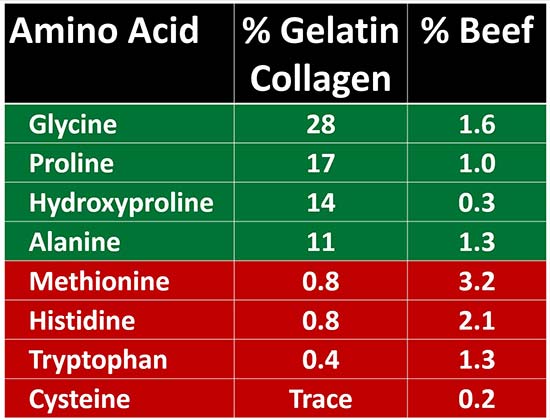
• The type of collagen you need — To achieve optimal bone health, you’ll need a balanced intake of muscle meat and collagen amino acids. Red meat alone won’t provide the amino acids you’ll need (highlighted in green below). Moreover, while the three primary amino acids of collagen have anti-inflammatory benefits, those found in red meat (highlighted in red) also promote inflammation.
• Optimal collagen intake — Ideally, a third of your overall daily protein intake will come from collagen or gelatin sources, because again, eating red meat alone won’t give you the amino acids you need for your body to produce new collagen. As noted in one study, “It is known that calcium excretion may rise with increased protein intake suggesting a detriment to bone mass.”13
• Healthy sources of collagen — I recommend making your own bone broth from organic, grass fed animal bones. For more gelatinous cuts of meat, slow-cooking and pressure-cooking are viable options. Consider taking collagen and gelatin supplements as well, if you’re still not meeting your needs. To learn how to make the best bone broth, read “The Ultimate Guide to Bone Broth: Nature’s Collagen Supplement.”
Lift Weights to Boost Skeletal Strength
According to research published in Endocrinology and Metabolism, resistance exercise (weightlifting) helps boost both muscle and bone health. In fact, findings indicate that it is especially helpful for older adults, as they are generally at higher risk for osteoporosis and sarcopenia. Even frail people who already experienced fractures can still benefit from resistance exercise, but safety will need to be followed to prevent further injuries.14
• You’ll benefit from most forms of weightlifting — Free weights, machines, or resistance bands will give your body a good workout. The study also noted that common exercises, such as squats, lunges, and back extensions, have a positive effect on bone health, particularly at the hip and spine.
• Not all impact exercises stimulate bone growth — While activities such as walking, swimming, and cycling boost your overall fitness, the study noted that they do not provide the impact needed to catalyze bone-formation mechanisms. In fact, frail people who undertake these activities have a higher chance of falling:15
“Regular walking, which is frequently prescribed to prevent osteoporosis, also has little or no effect on prevention of bone loss. This could be attributed that low-impact loading force applied during walking does not elicit loads of a sufficient magnitude, rate, or distribution to stimulate bone cells to lead to an adaptive skeletal response.
In addition, there is evidence that frequent walking can expose previously sedentary or frail older adults to an increased risk of falling, thereby increasing the risk of fracture.”
• Suggested frequency to build stronger bones — Based on the findings, weight training two to three times a week yields good results, especially when progressively increasing resistance over time.
• Seek out a licensed professional to assist your program — Taken altogether, lifting weights is undoubtedly a beneficial tool in combating osteoporosis. However, don’t just buy weights and start lifting mindlessly, especially if you’ve had a fracture before. As emphasized by the researchers:16
“The intensity and type of RE [resistance exercise] should be individualized according to tolerance and ability of adults, particularly in the presence of pain. At least two sets of one exercise for each major muscle group should be performed at a target intensity of eight to 12 repetition maximum (RM); however, for some individuals who are previously sedentary or unfamiliar with RE, it should be started at a lower intensity.”
If frailty is an issue, seriously consider KAATSU (also known as blood flow restriction training or BFR). Research shows BFR training matches the gains of heavy lifting, using only 30% of your 1-rep max. The low weight minimizes the risk of injury and is ideal for the elderly. Another excellent option is whole body vibration training.
Frequently Asked Questions (FAQs) About Hip Fracture Rates and Osteoporosis Treatment
Q: Why is osteoporosis considered a global health crisis?
A: Osteoporosis affects one in three women and one in five men over 50 worldwide, leading to fragile bones that fracture easily. Published research warns that hip fracture rates could double by 2050 due to aging populations and insufficient post-fracture care.
Q: What did the recent global study reveal about hip fracture trends?
A: While Western nations show stabilization in fracture rates, countries in Asia and South America face rapid increases linked to poor diet, sedentary lifestyles, and limited sunlight exposure.
Q: How can nutrients like calcium, vitamin D3, magnesium, and vitamin K2 support bone health?
A: Calcium strengthens bones, vitamin D3 helps the body absorb it, magnesium supports bone formation, and vitamin K2 directs calcium to bones instead of arteries. Altogether, they form a synergistic defense against bone loss.
Q: Why is collagen important for strong bones?
A: Collagen provides flexibility and resilience to bones, preventing fractures. For optimal bone health, a third of your total daily protein intake will ideally come from collagen-rich foods like bone broth, gelatin, and slow-cooked meats.
Q: What role does exercise play in preventing osteoporosis?
A: Weight-bearing and resistance exercises like squats, lunges, and resistance band training have been proven to increase bone density, whereas low-impact activities such as walking or swimming offer limited bone-strengthening benefits. Training two to three times per week under professional guidance is ideal.

